
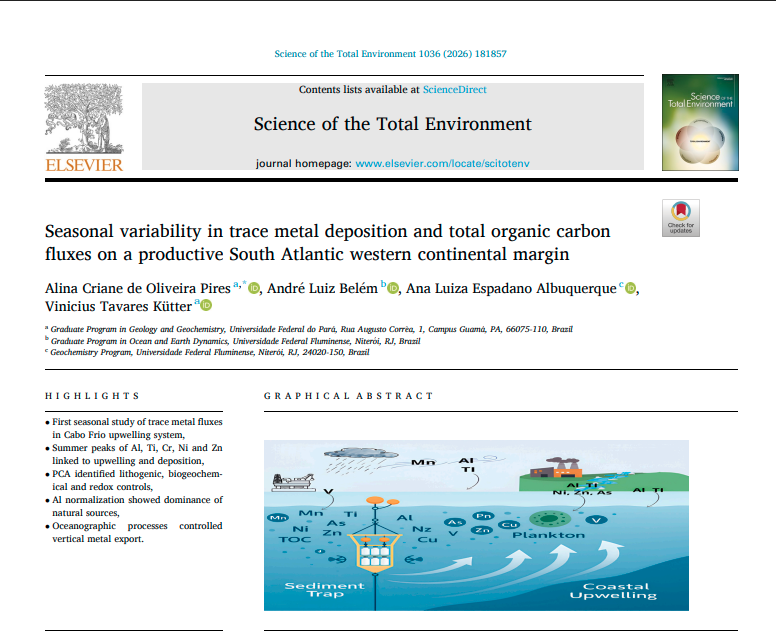
New article in Science of the Total Environment investigates trace metal and organic carbon fluxes on the Cabo Frio continental margin
The Oceanographic Observatory (O²/UFF) is pleased to announce the publication of the article Seasonal variability in trace metal deposition and total organic carbon fluxes on a productive South Atlantic western continental margin, published in the journal Science of the Total Environment.
The study’s first author is Alina Criane de Oliveira Pires, from the Graduate Program in Geology and Geochemistry at the Federal University of Pará, and it also includes co-authorship by André L. Belem, Ana Luiza S. Albuquerque and Vinicius T. Kütter. During the development of the manuscript, Alina spent a brief period at the Oceanographic Observatory (O²/UFF), strengthening scientific integration among the groups involved.
The research investigated the seasonal variability of trace metal and total organic carbon fluxes on the Cabo Frio continental margin, one of the most dynamic oceanographic regions of the South Atlantic western basin. The area is marked by the influence of coastal upwelling, the Brazil Current and the presence of South Atlantic Central Water (SACW), processes that control biological productivity, particle transport and sediment deposition on the seafloor.
The study used sediment traps installed on the external continental shelf off Cabo Frio to monitor, over 263 days, particle deposition and the variation of associated chemical elements. The results show that metal and carbon fluxes vary strongly throughout the year, reflecting the influence of oceanographic processes such as upwelling, downwelling, water mass circulation and specific hydrodynamic events.
The contribution of Prof. André and the O²/UFF was directly linked to the physical oceanography component, especially in the organization, processing and interpretation of oceanographic data used to understand how water mass dynamics control vertical transport of particles, trace metals and organic carbon.
This work also has special significance for the trajectory of O². When Prof. André Belem came to UFF, in Rio de Janeiro, in 2011, it was precisely to act in the physical oceanography component of this project in Cabo Frio, coordinated by Prof. Ana Luiza S. Albuquerque. Even after some time, the data series generated continues to produce relevant scientific results — and there are still many data to be analyzed and published.
The publication reinforces the importance of scientific collaboration networks between institutions and complementary areas, bringing together physical oceanography, marine geochemistry, biogeochemistry and time series analysis to understand the processes that connect ocean productivity, the carbon cycle and metal transport in the South Atlantic.
The final version of the article is available online on the page of Science of The Total Environment via ScienceDirect.