What is the Creation of Educational Elements Using 3D Printing project?
The Creation of Educational Elements Using 3D Printing project is a university outreach action developed within the Oceanographic Observatory at the Federal Fluminense University (UFF). It focuses on integrating additive manufacturing technologies into teaching, student training, and the production of tangible educational materials.
Situated within the context of active learning methodologies and the STEAM approach (Science, Technology, Engineering, Arts, and Mathematics), the project seeks to bridge theoretical concepts and practical applications, fostering meaningful learning, interdisciplinarity, and pedagogical innovation across different levels of education.
Objectives
The main objectives of the project are to:
- Develop three-dimensional educational elements to support teaching in areas such as engineering, natural sciences, biology, paleontology, and technology;
- Train university students in 3D modeling, 3D printing, equipment maintenance, and production workflow management;
- Integrate teaching, research, and outreach through the production of applied educational materials;
- Encourage the use of 3D printing as a pedagogical tool in both formal and non-formal educational contexts;
- Contribute to the technological and critical training of the students involved.
Methodology
The project adopts a methodology based on active learning approaches, combining technical training, laboratory practice, and pedagogical validation of the elements produced.
Activities include:
- Training in three-dimensional modeling and slicing software;
- Operation, calibration, and maintenance of 3D printers (mainly FDM);
- Development of models based on real pedagogical demands;
- Technical and didactic validation in collaboration with faculty from different fields;
- Systematic documentation of processes, aiming at reproducibility and knowledge sharing.
The entire process is organized through a structured workflow, from model conception to the delivery of the educational element and the preparation of user guides.
Examples of produced elements
During the pilot phase and the first year of implementation, several educational models were produced, including anatomical replicas and structures designed for teaching biology, evolution, engineering, and environmental sciences.
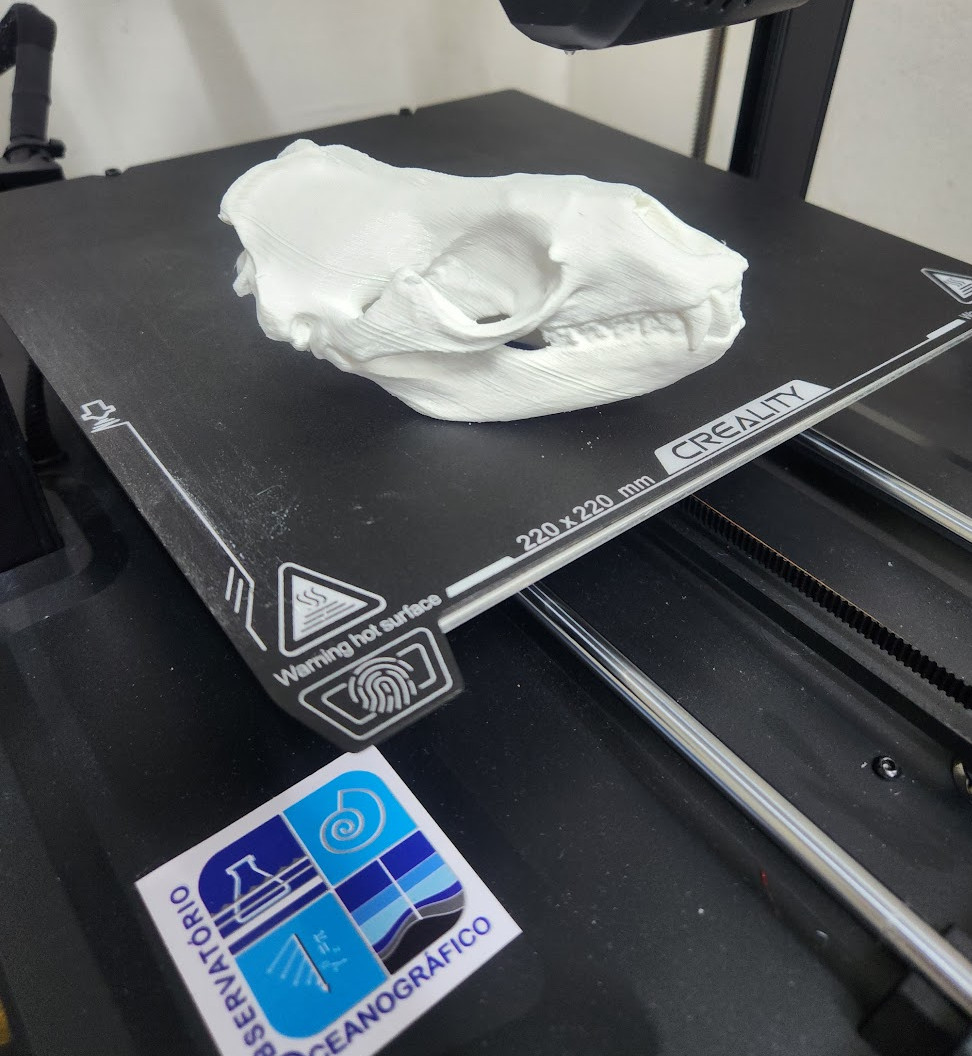
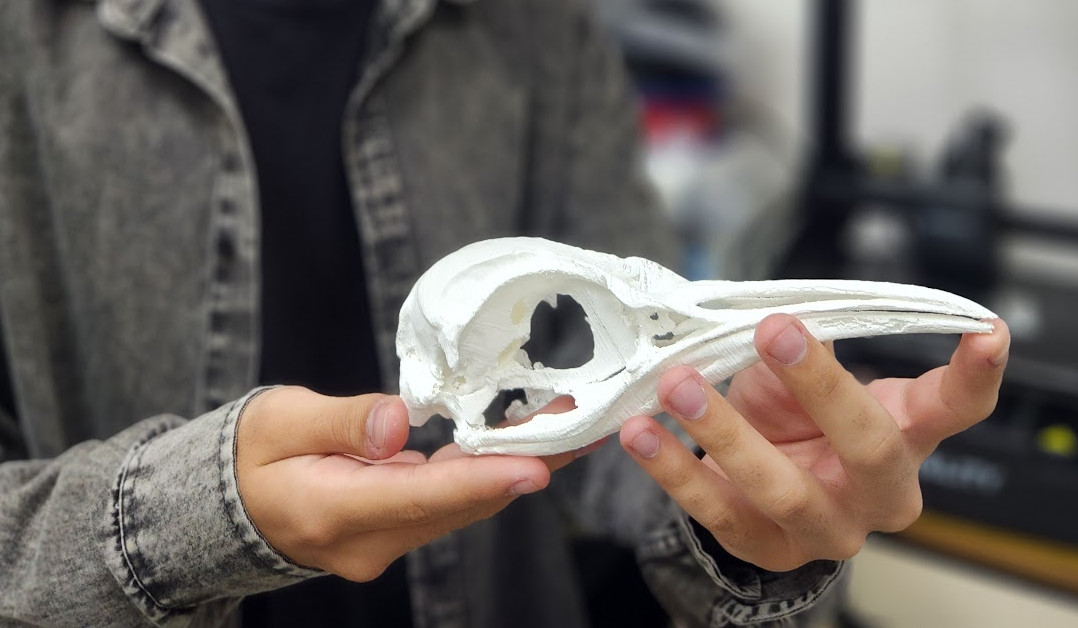
Among the developed products are:
- Anatomical and paleontological replicas (skulls and fossils of marine and polar organisms), used in teaching evolution and biology;
- Functional engineering models, such as gears, differentials, and mechanical systems;
- Structural components and supports for educational electronics projects;
- Replacement parts and improvements for the laboratory’s own 3D printers.
Expected outcomes
Throughout its duration (2025–2027), the project aims to:
- Consolidate a continuous workflow for the production of 3D-printed educational elements;
- Expand the technical and pedagogical training of university students;
- Broaden the use of the produced materials in courses, workshops, and outreach activities;
- Strengthen partnerships with schools, laboratories, and other institutions;
- Advance the development of accessible models, including materials designed for people with visual impairments;
- Make protocols, models, and user guides openly available, promoting replicability and social impact.
These outcomes are conceived as progressive processes, assessed throughout the project’s execution in line with university outreach guidelines.
Institutional support
The Creation of Educational Elements Using 3D Printing project is a university outreach action registered in SIAEX and receives institutional support from the Office of Outreach (Pro-Rectory of Extension) of the Federal Fluminense University (PROEX/UFF), reinforcing its public, academic, and social character.